
August gives us the opportunity to celebrate both Women’s Month and TVET Month, reminding us that the future of South Africa’s automotive repair industry depends on recognising talent wherever it is found. At SAMBRA, we believe it is time to move beyond outdated stereotypes and focus on developing the skills, passion and professionalism that will drive our sector forward. By encouraging more women to pursue rewarding technical careers and strengthening the pathways between vocational training and the workplace, we are helping to build a more diverse, capable and sustainable industry for the future.
Women helping to drive South Africa’s automotive aftermarket forward
As South Africa celebrates Women’s Month, the Retail Motor Industry Organisation (RMI) recognises the growing contribution of women across its approximately 8,500 employer members.
Women are no longer participating only in traditionally administrative or support roles. Across vehicle dealerships, independent workshops, panel beating businesses, parts operations and fuel retail establishments, women are working as sales professionals, technical specialists, qualified artisans, departmental managers, business owners and dealer principals.
From training to meaningful career progression
The available evidence nevertheless shows that progress remains uneven. Women are entering the automotive skills pipeline in encouraging numbers, but the existing workforce remains approximately 70% male. The challenge is therefore not only to recruit women, but also to ensure that they receive meaningful workplace exposure, complete their training, qualify, secure employment and progress into senior technical and leadership positions.
| Women are contributing across the full value chain. From customer-facing and commercial roles to technical trades, workshop leadership and business ownership. |
Almost 95,000 women in the MIBCO workforce
The MIBCO sector-level extract dated 21 July 2026 recorded 316,945 employees across its seven sector classifications. Of these, 94,998 were women, representing approximately 30% of the workforce.
This was a modest improvement from the August 2024 snapshot, when women accounted for 29.7% of 305,309 employees. The overall figure, however, does not fully reflect the different roles women perform or the differences between sectors.
Women in panel beating and collision repair
Women are also increasingly visible within panel beating and collision-repair establishments. Several businesses have women as owners or managers, while women are also working as spray painters, panel beaters and vehicle damage quantifiers — commonly known as estimators.
Vehicle damage quantifiers assess vehicles involved in accidents, identify visible and possible underlying damage, determine the repair processes required and prepare estimates for customers, insurers and other stakeholders.
The role requires technical understanding, attention to detail, knowledge of repair methods, parts and labour calculations, strong communication skills and the ability to work accurately within customer and insurer requirements.
Female spray painters and panel beaters are similarly demonstrating that technical competence is not determined by gender. Their presence provides important role models for young women considering careers in collision repair, refinishing and related occupations.
Beyond stereotypes: Two women building careers in spray painting
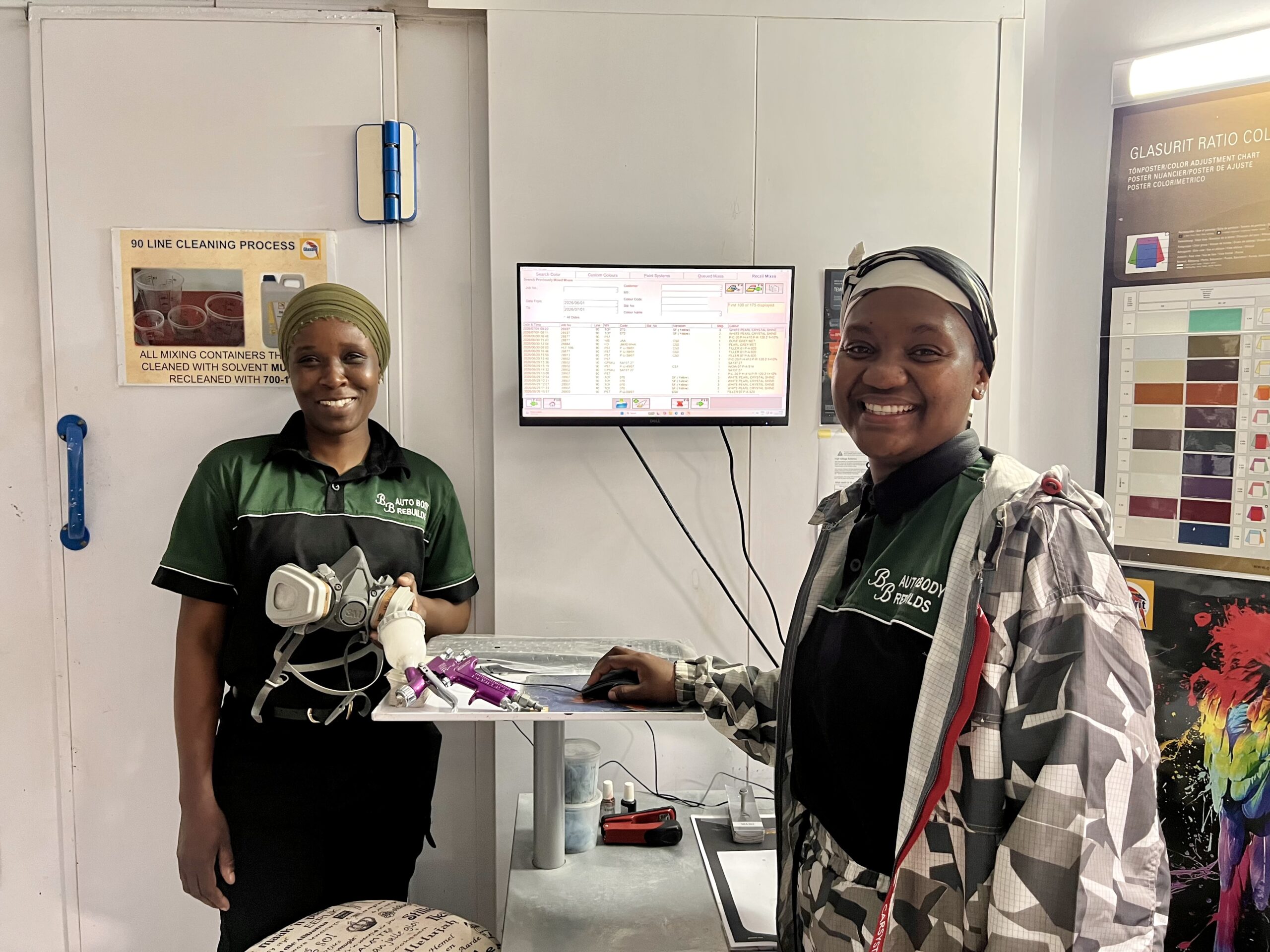
For many people, automotive spray painting still conjures up images of a trade dominated by men. Yet quietly, inside the paint shop at BB Auto Body Rebuilds, that perception is changing.
Here, two women, Sina Mokgadi Ratshilumela and Paulina Matlhabe, are proving every day that precision, patience and craftsmanship know no gender. Under the leadership of owner Santie Boshoff and Chief Operating Officer Sonja de Beer, both women themselves, they are building careers in a profession where female representation remains the exception rather than the norm.
For the South African Motor Body Repairers’ Association (SAMBRA), a proud association of the Retail Motor Industry Organisation (RMI), stories like these perfectly capture this year’s Women’s Month theme, “Building Resilient Economies for All.” They demonstrate that when women are given opportunities to learn, qualify and lead, they strengthen not only businesses but the future of South Africa’s automotive sector.
“There is still a misconception that automotive repair, particularly spray painting, is physically demanding work best suited to men,” says Juan Hanekom, National Director of SAMBRA. “The reality is that modern vehicle refinishing is a highly skilled profession requiring technical knowledge, exceptional attention to detail, colour accuracy and craftsmanship. It is ideal for anyone with this kind of special talent.”
For 30-year old Sina, the industry was never part of a carefully mapped career plan.
“Spray painting found me,” she says. “I have always enjoyed technical work and working with tools. What fascinated me was seeing a vehicle transformed from preparation to a beautifully finished product. But it was also about proving that I belonged in what many still see as a man’s world.”
Today, she is only one assessment away from qualifying as a professional spray painter – an achievement she once believed impossible. She is currently completing her qualification – CBMT the Legacy Qualification programme – and is busy with Level 3 training. Her trade test has been scheduled for 29 and 30 July 2026, after which she is expected to qualify as a spray painter.
Her proudest moment has been completing an entire vehicle on her own, from preparation and priming through to masking and the final coat of paint.
“Women are the secret weapon,” she laughs. “We have patience and delicate hands that allow us to feel even the smallest imperfections before anyone else can see them.”
Paulina’s journey into the trade began even more unexpectedly. This 38-year old started as a car wash assistant but constantly looked for opportunities to grow.
“When I was given the chance to work in the paint shop, it changed my life,” she says. “Doing more has always been my motto.”
Although she is still completing her training having just finished phase 1 of her Occupational Certificate for Vehicle Spray Painter, she already takes enormous pride in producing quality work and continues to challenge herself to improve every day.
Like Sina, she believes women bring particular strengths to the profession.
“We pay attention to detail. We want the job done properly, and if we make a mistake, we learn from it and do it better the next time.”
Both women acknowledge that entering a male-dominated trade can be intimidating, but they are equally quick to recognise the support they have received from their colleagues.
“The men I work with have always encouraged us to keep learning, pass our assessments and believe in ourselves,” says Paulina.
Sina agrees. “I’ve learned that nothing comes easily. You have to work hard and keep improving every day.”
For Hanekom, their success highlights the importance of supportive workplaces that invest in people based on ability rather than stereotypes.
“One of the biggest challenges facing South Africa’s motor body repair industry is attracting enough skilled artisans. We simply cannot afford to overlook half the country’s talent. Businesses that embrace diversity are building stronger teams, creating more resilient organisations and helping secure the future of our sector.”
Creating opportunities for women in motor body repair
The fact that Sina and Paulina are developing their careers within a business owned and managed by women makes their story even more significant.
Boshoff and De Beer have created an environment where women are not only welcomed into the industry but are actively encouraged to grow, qualify and build long-term careers. Prior to the two current ladies, the company had already qualified four female spray painters. They are continuing to strengthen female representation in the automotive body repair and refinishing sector while contributing to skills development and gender transformation within the industry.
Opening the door for the next generation
For both apprentices, Women’s Month is about much more than recognition.
It is about showing other young women what is possible.
“My work shows other women that nothing is impossible,” says Sina. “As more women build businesses, create jobs and teach valuable skills, we help grow South Africa’s economy.”
Paulina echoes that sentiment.
“When other women see me working as a spray painter, they begin to believe they can do it too.”
Both already have their eyes firmly fixed on the future.
Sina hopes to qualify soon before one day mentoring the next generation of spray painters. “I want to teach others everything I have learned.”
Paulina dreams even bigger. “In five to ten years, I see myself working overseas.”
Hanekom says these ambitions reflect exactly what Women’s Month is intended to celebrate.
“Building resilient economies starts with building resilient people. Every qualified artisan strengthens our economy, every successful business creates opportunity, and every woman who enters our industry opens the door a little wider for those who follow. Sina and Paulina are excellent examples of why the future of our industry depends on talent, dedication and opportunity rather than gender,” he concludes.


